Is Avocado Really Good to Lower Cholesterol?
How can you benefit from avocado and meet the American Heart
Association (AHA) dietary guidelines at the same time?
What types of
fats are found in avocado?
How do saturated and unsaturated fats affect
your heart?
How much avocado you can eat each day?
Find all the answers to your worrisome questions in the following paragraphs.
Let me start with an interesting story I have read about George. He is an avocado farmer from California, he is a healthy 80 years old man weighing 170 pounds and as tall as 5.5 feet.
He has been eating 3 avocados each day of his long happy life. Along with exercise, he thinks that his precious greens are the reason for the good health for him and his entire family.
Avocado cholesterol – how much does it affect our body?

The first interest for cholesterol in avocado was caught by some polish scientists in 1996 who proved that eating avocado each day can lower your total blood cholesterol levels by seventeen percent.
Besides, your LDL “Bad cholesterol”, triglycerides and your risk for developing heart diseases will be reduced, moreover, the levels of your HDL “good cholesterol will show marked as increased.
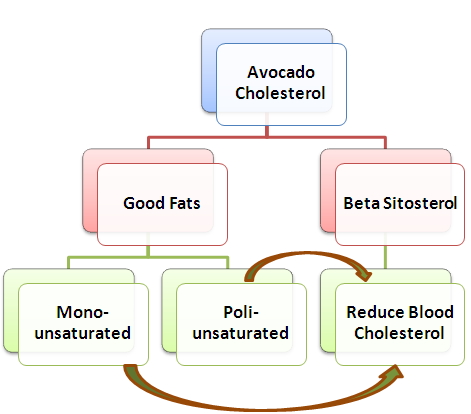
- Scientists also discovered that the role of avocado in cholesterol reducing is enhanced by beta-sitosterol, a natural component of avocado, scientifically proved to reduce the total cholesterol levels in the blood. According to researches published in the American Journal of Medicine, beta-sitosterol has shown to lower total cholesterol levels in sixteen human studies.
It is 100% true that avocado is rich in fats, that is why it is also called “Butter Pear”. For your information, an avocado (medium sized) contains about thirty grams of fat, which equals the amount of fats found in ¼ pound burger.
- According to the American Heart Association (AHA), your first strategy to limit your high risk for developing cardiovascular diseases is to know which fats increase your LDL “Bad cholesterol” and which fats don’t.
Saturated and trans-fats, as well as dietary cholesterol can raise your blood LDL cholesterol significantly, while monounsaturated fats and polyunsaturated fats has no effect on your LDL cholesterol, furthermore, some of them will markedly increase your HDL “Good cholesterol”.
Therefore, if you consume mono and polyunsaturated fats in moderation and eat them instead of saturated and trans-fats, you will lower your blood cholesterol levels and reduce your risk for heart disease.
- Avocado is from the few fruits which contain good fats; i.e. mono and polyunsaturated fats, additionally, one ounce serving of avocado can provide you with 3 grams of mono-unsaturated fats and ½ a gram of polyunsaturated fats.
But remember, though avocado
effect in lowering cholesterol is well proved, avocado still contains a lot of
calories due to its high content of fats.
Fats of whatever type have twice number of calories of the similar amount of carbohydrates.
Therefore to enjoy avocado and meet AHA dietary guidelines, the recommended serving of avocado per day is two tablespoons or 1/6 of a medium sized avocado. Indeed, this serving will provide you with five grams of fat and fifty five calories.
Related: Hebs and Food for lowering Cholesterol
 Avocado |
 Cinnamon |
 Nuts |
 Oat Meal |
 Red yeast Rice |
What is recently discussed in the Cholesterol Questions and Answers Room:


New! Comments
Have your say about what you just read! Leave me a comment in the box below.